What makes a road a dual carriageway, the speed limit for cars, which lane to use, and how to join and leave from a slip road on your driving test.
A dual carriageway is a road where a central reservation separates the traffic going in each direction. The national speed limit for cars on a dual carriageway is 70 mph, unless signs show a lower limit. Keep to the left lane and use the right lane only to overtake or turn right (rule 137).
A dual carriageway has a central reservation: a strip, often with a barrier or grass, between the two directions of traffic. It is the central reservation that makes it a dual carriageway, not the number of lanes or the speed limit. Many have two lanes each way, and some have three or more (rules 137 and 138).
Unlike a motorway, a dual carriageway can have roundabouts, traffic lights, side roads and gaps where traffic crosses the central reservation. Cyclists and slow vehicles may use it too.
Learner drivers can drive on dual carriageways. The motorway is the only type of road with a special rule for learners, so dual carriageways are part of normal lessons and can be part of your test.
For cars, the national speed limit on a dual carriageway is 70 mph (rule 124). Learners have the same limits as full licence holders. Many dual carriageways have a lower local limit, shown on signs. On a dual carriageway, the national speed limit sign, a white circle with a black diagonal stripe, means 70 mph for cars.
70 mph is a maximum, not a target (rule 125). Keep at least a two second gap to the vehicle in front, and at least double it in the wet (rule 126). For the limits on other roads, see the national speed limit on every type of road.
On a two lane dual carriageway, keep to the left lane. Use the right lane to overtake or to turn right, then move back to the left when it is safe (rule 137). On three or more lanes, you may use the middle lane or the right lane to overtake, then return to the left (rule 138).
To change lanes, check your mirrors, take a quick glance over your shoulder into the blind spot, signal, and move only when there is a safe gap (rules 133 and 134). Follow any lane arrows on the road.
Many dual carriageways are joined by a slip road. Traffic already on the main road has priority.
The Highway Code describes this method for joining a motorway (rule 259), and it works the same way on a dual carriageway. Some slip roads are short, or end at a give way line. There you MUST give way to traffic on the main road (rule 172), so you may need to slow down or stop and wait for a gap.
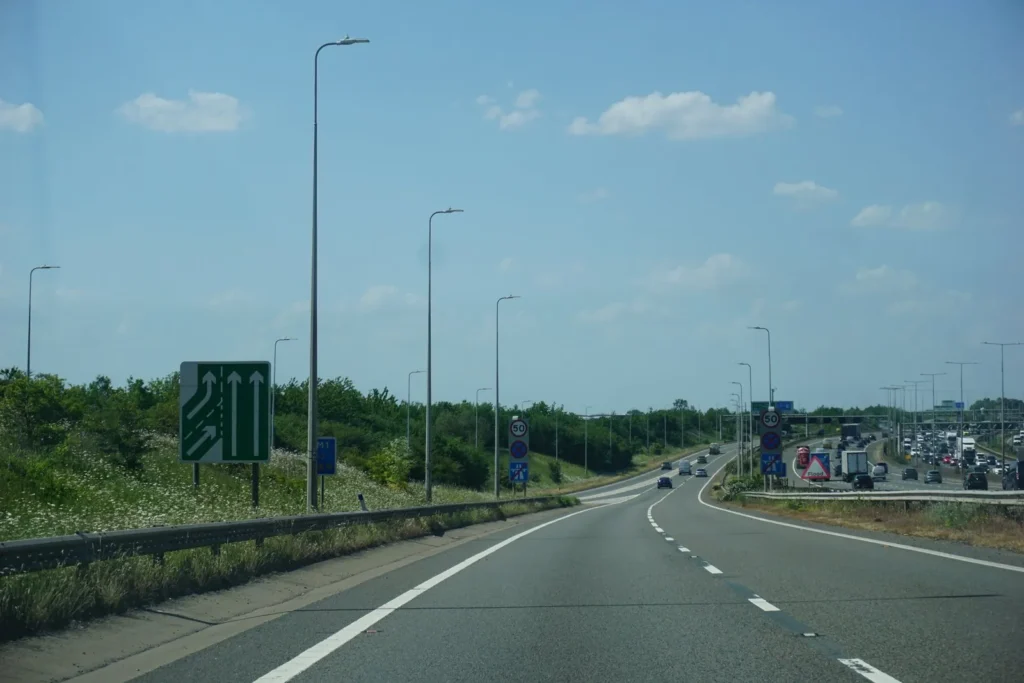
Watch for the signs to your exit and move into the left lane in good time. Signal left, then slow down on the slip road. After driving fast, 50 mph can feel like 30 mph, so check your speedometer as you come off. This is the method the Highway Code gives for leaving a motorway (rules 273 and 274), and it works the same way here.
Some dual carriageways have gaps in the central reservation where you can turn right or cross. Before you use one, check whether the gap is deep enough to hold your whole car. If it is, treat each half as a separate road: cross the first half, wait in the gap, then cross the second. If it is not, wait until you can cross both halves in one go (rule 173).
To turn right from the dual carriageway into a gap, check your mirrors, signal right and move to the right lane in good time.
The dual carriageway ends sign warns you that the road ahead becomes a single carriageway, with traffic coming towards you on the same road. Move back to the left lane in good time, and do not start an overtake you cannot finish before the lanes merge.
The speed limit can change here too. Where the national speed limit applies, the limit for cars drops from 70 mph to 60 mph on a single carriageway (rule 124).
Since 24 November 2025, DVSA has used more high speed and rural roads on test routes where the location allows. If there is a dual carriageway near your test centre, it may well be on your test.
DVSA's top 10 reasons for failing (April 2024 to March 2025) include three dual carriageway examples:
Use of speed is marked too. How driving test faults are marked explains when a mistake on a fast road becomes serious.
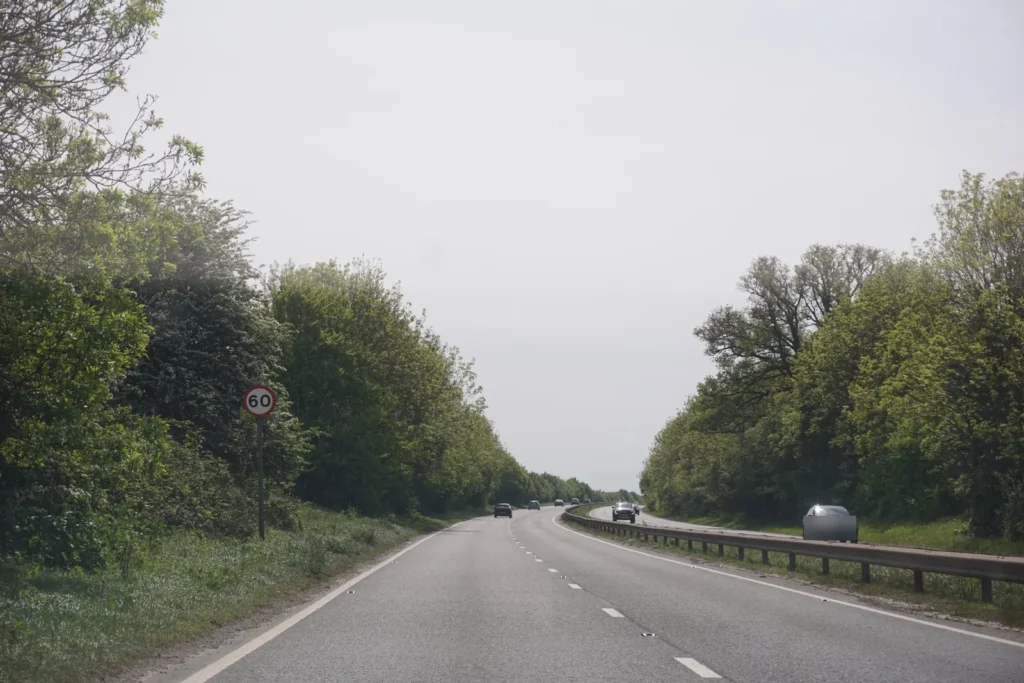
Ask your instructor to include dual carriageways and slip roads in your lessons, so the speed feels normal before test day. Once you are confident on them, you could ask about motorway lessons for learner drivers.
Find your test centre to see the dual carriageways and slip roads around it in 4K. You can learn the signs you will see on them with UK road signs and their meanings, and plan the rest of your preparation with how to pass your driving test.
For cars, 70 mph where the national speed limit applies. Lower limits are shown on signs, and the limit is a maximum, not a target.
Yes. The only road with a special learner rule is the motorway. Dual carriageways are part of normal lessons and can be on your test.
A short road used to join or leave a dual carriageway or motorway. You use it to match your speed before joining, or to slow down after leaving.
The road ahead becomes a single carriageway with traffic coming towards you. Move back to the left in good time, and remember the national limit for cars falls to 60 mph.
Yes, unless you are overtaking or turning right. Then move back to the left when it is safe (rule 137).
Last checked: 13 October 2026.
