What the national speed limit sign means for a car on each type of road, why 60 mph is often too fast on a country lane, and how examiners judge your speed.
The national speed limit for a car is 60 mph on a single carriageway and 70 mph on a dual carriageway or motorway. In built-up areas the limit is 30 mph. The national speed limit sign, a white circle with a black diagonal stripe, tells you the limit for that type of road now applies.
These are the national limits for cars and motorcycles in England (rule 124):
| Type of road | Limit for cars |
|---|---|
| Built-up areas | 30 mph |
| Single carriageways | 60 mph |
| Dual carriageways | 70 mph |
| Motorways | 70 mph |
Learners have the same limits as full licence holders. Buses, coaches and goods vehicles have lower limits on some roads. Local limits apply where signs show them, for example 20 mph in some built-up areas, or 40 or 50 mph on some country roads. In Wales the limit in built-up areas is 20 mph.
The sign has no number on it. It means the national limit for your vehicle on that type of road now applies, and it ends any lower limit you were in. So the same sign means 60 mph on a single carriageway and 70 mph on a dual carriageway.
It does not mean there is no limit, and it does not tell you to drive at 60 or 70.
To know which limit applies, look at the road. If a central reservation separates the two directions of traffic, it is a dual carriageway and the limit for cars is 70 mph. If not, it is a single carriageway and the limit is 60 mph, even if there are two lanes going your way.
A road with street lights usually has a 30 mph limit, unless signs show otherwise. Where a lit road has a different limit, signs tell you.
Many country lanes carry the national speed limit, so the legal limit is 60 mph. That is the most you may drive, not a target. The Highway Code says the speed limit is the absolute maximum and does not mean it is safe to drive at that speed in all conditions (rule 125). On a narrow lane with bends, hidden junctions and no pavement, a safe speed can be far lower.
Rule 154 asks you to take extra care on country roads, at bends, junctions and village entrances. The test of a safe speed is simple: can you stop well within the distance you can see to be clear (rule 126)? If you cannot see round a bend, slow down before it, not in it.
On a single track road, pull into a passing place on your left, or wait opposite one on your right, to let oncoming traffic pass. Give way to vehicles coming uphill where you can, slow down for pedestrians, cyclists and horse riders, and do not park in passing places (rules 155 and 156).

Since 24 November 2025, DVSA has used more high speed and rural roads on test routes where the location allows. If there are national speed limit roads near your test centre, expect to drive on some of them.
DVSA's top 10 reasons for failing (April 2024 to March 2025) put not driving at a safe and reasonable speed at number 10. One of its examples is approaching a sharp bend on a national speed limit country road too fast and losing control. Another, under traffic signs at number 8, is reacting far too late, or not at all, when a sign shows a change of speed limit.
The examiner wants to see you drive at a speed where you can stop safely, well within the distance you can see to be clear. The examiner guidance also lists driving too fast for the road, traffic and weather as a fault. How driving test faults are marked explains when a speed mistake is a driving fault and when it is serious.
Limits change often on a drive: a 30 mph village, a national speed limit stretch, then a 40 mph limit at the edge of the next town. Look well ahead for the signs. Slow down so that you are at the new, lower limit by the time you reach the sign, not after it.
Gaps matter as much as speed. Keep at least a two second gap on faster roads, double it in the wet and allow up to ten times the gap on icy roads (rule 126). Driving in ice, rain and fog covers this in more detail, and dual carriageway lanes and slip roads covers the 70 mph roads.
Speeding carries a minimum penalty of £100 and 3 points, for learners too. Unexpired points on a provisional licence carry over when you pass, and if you reach 6 or more within 2 years of passing, your licence is revoked.
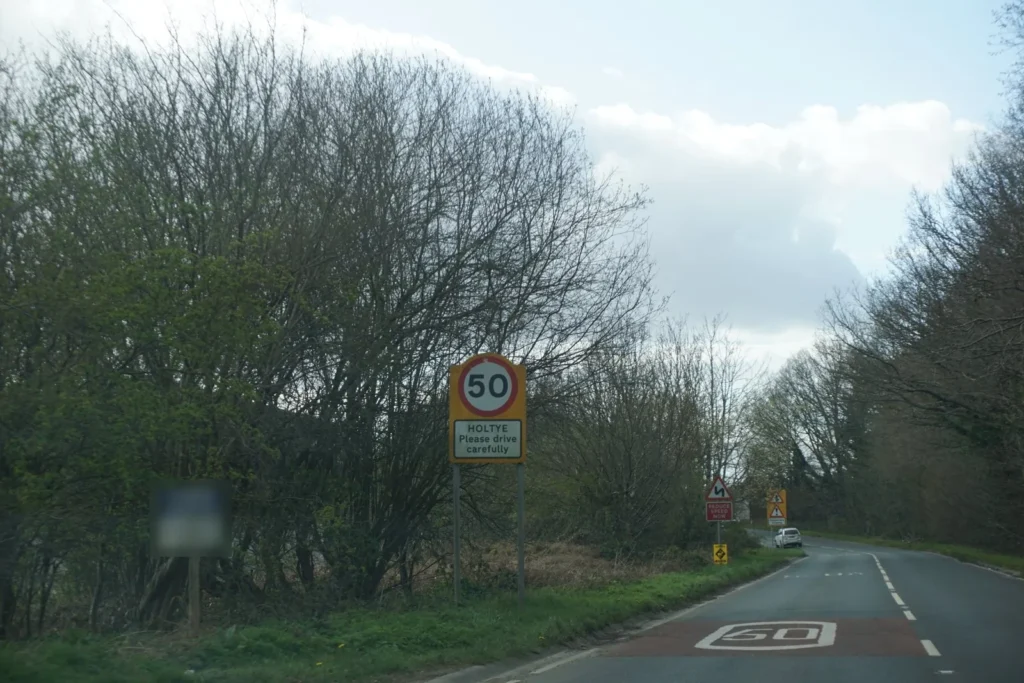
Ask your instructor to include country roads and national speed limit stretches in your lessons, in daylight and in the dark. The more often you meet them, the easier it is to pick a safe speed without thinking.
Find your test centre and watch the country roads and speed limit changes around it in 4K. Every speed limit sign is on UK road signs and their meanings, and how to pass your driving test shows where speed fits into the rest of your preparation.
For cars, 60 mph. Lower limits apply where signs show them, and you must still drive at a speed that suits the road and the conditions.
For cars in England, 60 mph on single carriageways and 70 mph on dual carriageways and motorways. In built-up areas the limit is 30 mph.
It depends on the road. For a car it means 60 mph on a single carriageway and 70 mph on a dual carriageway or motorway.
No. In England, learners have the same speed limits as full licence holders.
Last checked: 13 October 2026.
