A mini roundabout is small, but the rules match a big one, with less time to act. Who goes first, how to signal, and why you never drive over the white circle.
The mini roundabout rules are the same as for any roundabout, with less room and less time. Give way to traffic from your right, drive round the white central circle rather than over it, and signal as you would at a normal roundabout where there is time. Highway Code rule 188 also tells you to avoid U-turns.
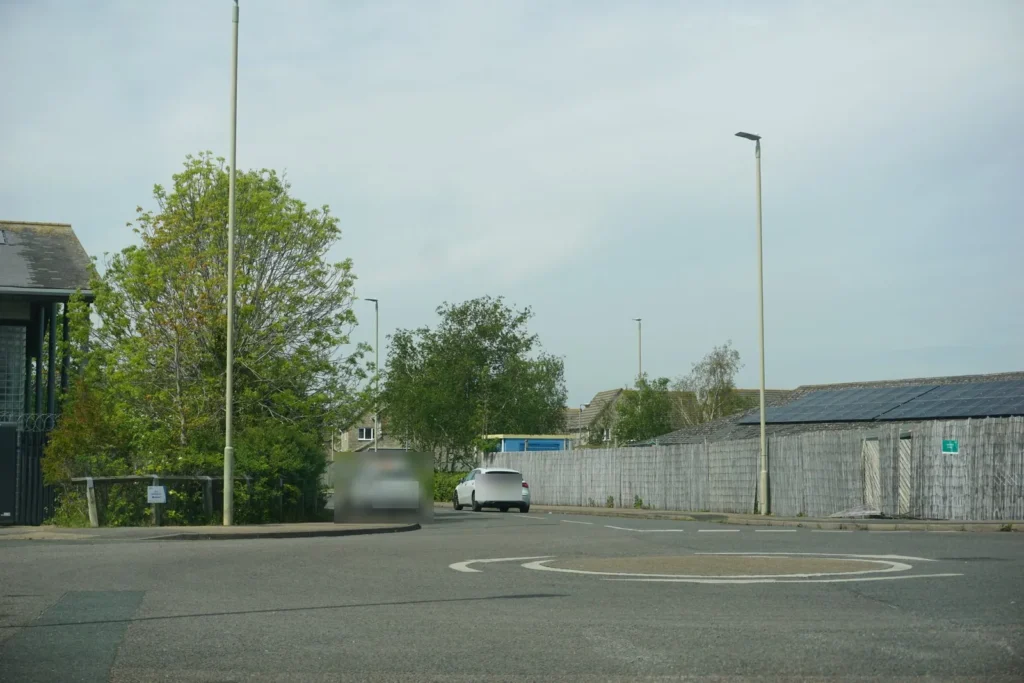
A mini roundabout is a junction with a white painted circle in the middle instead of a raised island. Government guidance for road designers describes the circle as 1 to 4 metres across, flush with the road or slightly domed, so that large vehicles can drive over it. Three white arrows painted around it show that traffic goes clockwise.
On each approach you will see a blue circular sign with three white arrows. That is the mini roundabout sign, and it is an order rather than a warning: give way to traffic from your immediate right and go round. Broken white give way lines mark where you wait.
The same guidance recommends mini roundabouts only where the speed limit on the approaches is 30 mph or lower, so you meet them mostly in towns, on estates and on quiet local roads.
Traffic from your right goes first. That is the rule at every roundabout (rule 185), and the mini roundabout sign repeats it. Look right early: on a junction this small, a car from the right reaches you quickly.
Watch the car opposite as well. If it is turning right, it comes round the circle and passes across your entry, so from that moment it is traffic from your right.
When cars are waiting on every arm, someone has to go first. Do not assume you will be waved out, and do not flash your lights to let someone else go: the examiner guidance lists flashing headlights to let someone go as a signalling fault. Wait until another driver either moves or clearly holds back, then go when it is safe.
If you mix up the blue sign with the red triangle that warns of a roundabout ahead, our guide to telling the mini roundabout sign from the roundabout sign puts them side by side.
Rule 188 tells you to approach a mini roundabout in the same way as a normal one, so the usual signals from rule 186 apply:
The same rule warns that there is less time to signal. The left signal you would give as you pass the exit before yours often does not fit, because the exits are so close together. Give it only if it helps someone waiting at the next arm and cannot be mistaken for a turn into an earlier road. Rule 103 asks you to check that a signal will not mislead before you give it.
All vehicles must pass round the central markings, except large vehicles that are physically unable to (rule 188). The government guidance on mini roundabouts adds that drivers who could have gone round but drove over the circle risk prosecution. Treat the paint as if it were a kerb.
Turning right needs the most care. Keep the circle on your right and steer round its far side, rather than cutting across the near side of it. Slow down enough to make the turn without clipping the paint.
Buses and lorries may have to drive over the marking. Give them room and wait for them to clear before you go.

Rule 188 asks you to avoid U-turns at mini roundabouts and to watch for other drivers making them. A U-turn there is legal, but other drivers do not expect it, and it takes you back across the traffic you have just given way to.
At a double mini roundabout, treat each one separately and give way to traffic from the right at each (rule 189). Where a complex junction has a series of them, the same applies to every one (rule 190). Before you go into the first, check that there is room to wait between the two, so you do not end up stopped across someone else's path.
There is no separate mini roundabout box on the test report. Mistakes go under the usual headings in the guidance examiners use:
Not making effective observations at junctions was the most common reason for failing in the DVSA list for April 2024 to March 2025. At a mini roundabout that usually means a late look right, or pulling out when a car was already coming round. See how examiners grade driving faults, serious faults and dangerous faults.
For lane choice and exit signals on bigger junctions, see our guide to roundabout lanes, signals and priority. Junction work like this is a large part of how to pass your driving test. To see the mini roundabouts near you, find your test centre and watch the roads learners there drive most often.
Traffic coming from your right. The blue mini roundabout sign says the same thing: give way to vehicles from the immediate right.
Use the normal roundabout signals where there is time: left on the approach for a left turn, right for a right turn, and none on the approach for ahead. There is less time to signal (rule 188), so leave out any signal that could mislead.
No, unless your vehicle is too large to get round it. Every other vehicle must pass round the central markings (rule 188).
It is not illegal, but rule 188 tells you to avoid U-turns at mini roundabouts and to watch for drivers who make them.
Treat each mini roundabout separately and give way to traffic from your right at each one (rule 189).
Last checked: 13 October 2026.
