Rules for roundabouts in the UK: lanes, signals and who goes first
Know who goes first, which lane to use for left, ahead and right, and exactly when to signal, so the roundabouts on your test feel routine instead of rushed.
8 min read·Intermediate
TRWritten by the Testroute teamChecked against DVSA guidance and The Highway Code · Updated 13/10/2026
The rules for roundabouts in the UK come down to three habits. Give way to traffic coming from your right, choose your lane early from the signs and road markings, and signal so other drivers know which exit you want. Highway Code rules 184 to 187 cover roundabouts, and rule 186 sets the lanes and signals.
Who goes first at a roundabout
Give priority to traffic coming from your right, unless signs, road markings or traffic lights tell you otherwise (rule 185). In practice that means the traffic already going round, and anyone about to pass across your entry.
You do not have to stop if the way is clear. Waiting when you could have gone can be marked on the test as hesitation, so look right early, while you still have time to judge the gap.
Two more points from rule 185 catch learners out:
Drivers already on the roundabout may not signal, or may signal the wrong way. Wait until you can see what a car is doing, not what its indicator says.
Before you move off, look ahead as well and make sure the car in front has actually gone. Learners who only look right can roll into the back of it.
Where road markings let you enter without giving way, still look right before you join (rule 185). Small roundabouts painted on the road follow the same priority with less room, covered in our guide to mini roundabout rules.
Roundabout lanes and signals: which lane for each exit
Rule 186 sets a default for lanes and signals. Signs and road markings override it, so read them first. Where they say nothing, use this:
Your exit
Lane on the approach
Signal on the approach
Signal to leave
First exit (left)
Left lane
Left
Keep the left signal on until you leave
Any exit in between, often straight ahead
The lane the signs and markings show for your exit
None, normally
Left, once you pass the exit before yours
Exit to the right, or full circle
Right lane
Right
Left, once you pass the exit before yours
When you go right, stay in the right lane until you need to change lanes to leave. If there are more than three lanes at the entry, use the most suitable lane on the approach and through the roundabout. Some large roundabouts have their lanes painted on the roundabout itself; our guide to spiral roundabouts and their lane markings shows how those lead you out.
The exit signal matters more than learners think. Drivers waiting to join use your left indicator to decide whether to pull out. Give it as you pass the exit before yours. Signal too early, and a driver joining at that exit may think you are leaving there and pull out in front of you. Signal too late, and drivers further round have to guess.
Lanes and signals for left, ahead and right at a four-arm roundabout, giving way to traffic from the right.
Your test centreFind your test centreSee the roads learners around it drive most often, filmed in 4K from the driver's seat.
Roundabout rules step by step: approach, join, leave
Read the signs early. A red warning triangle may tell you that a roundabout is coming, and the direction sign after it shows the layout and where each exit goes. Count the exits so you know whether yours is left, ahead or right. Our guide to the roundabout sign and the mini roundabout sign shows the two side by side.
Check your mirrors, signal if your exit needs one, then move into your lane. This is the mirror, signal, manoeuvre routine that examiners watch at every junction.
Slow down in good time, so you arrive at a speed where you can look right and still either stop or go.
Look right early, then ahead, then right again. Judge the gap against the traffic that will reach your entry, not cars far round the roundabout.
Go when it is safe, or stop at the line when it is not. Keep to your lane as you go round.
Check your left mirror after you pass the exit before yours, then signal left. Look for cyclists on your left before you turn off.
Leave in the lane you are in, and make sure your signal cancels once you are off.
Watch the front wheels of cars coming round, not just their indicators. Wheels turning towards an exit tell you more than a signal that may have been left on by mistake.
Cyclists, pedestrians and long vehicles on roundabouts
Rules 186 and 187 ask you to leave room for the people most at risk on a roundabout.
Cyclists: give them priority on the roundabout, leave plenty of room and do not overtake them within their lane. Cyclists and horse riders may stay in the left lane all the way round and signal right to show they are not leaving. Do not cut across them as you enter.
Pedestrians: give plenty of room to anyone crossing the roads in and out of the roundabout. Look at the crossing point on your exit road before you turn into it.
Motorcyclists: they are easy to miss at roundabouts (rule 211), so take a second look right before you go.
Long vehicles: lorries and vehicles towing trailers may take a different line or straddle two lanes. Hang back and watch their signals rather than driving alongside.
Drivers out of position: give room to anyone straddling lanes, or crossing in front of you to leave at the next exit.
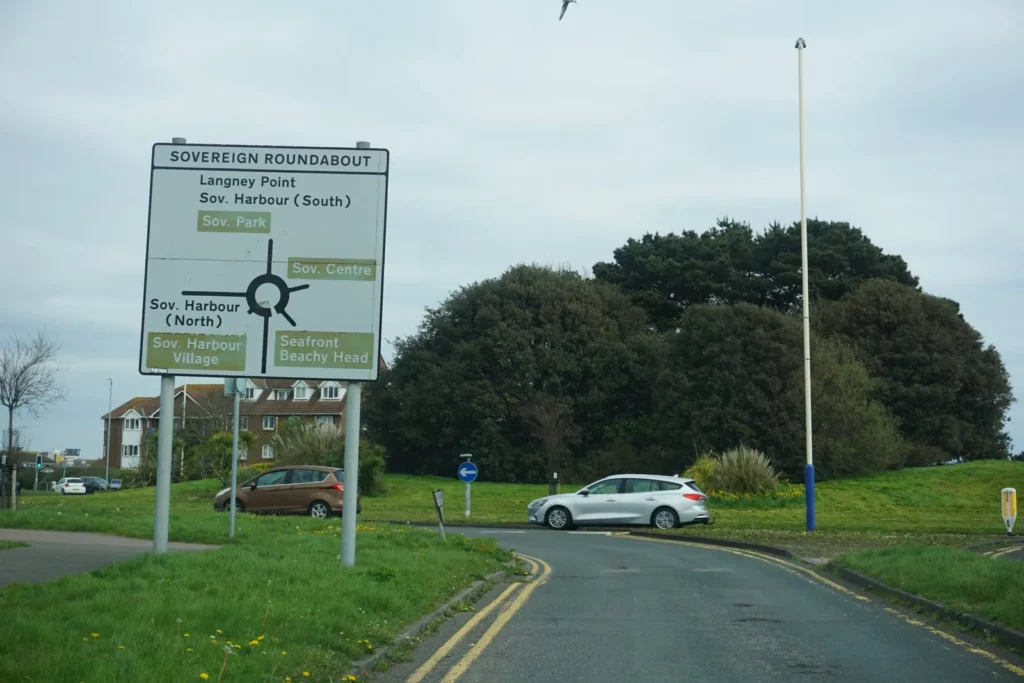
The map type sign for Sovereign Roundabout in Eastbourne, March 2026
What the examiner looks for
There is no separate roundabout box on the test report. In the guidance examiners use, roundabout mistakes are recorded under the usual headings, including:
Junctions: approaching too fast or too slowly, and not looking effectively before you emerge. Looking both ways and then pulling out into someone's path still counts.
Signals: an exit signal given late, or a signal that misleads.
Positioning: cutting across the normal road position when going ahead.
Progress: stopping at a junction for no reason, or not going when it is safe.
Response to road markings: not following the lane arrows.
Not making effective observations at junctions was the most common reason for failing the car test in the DVSA list for April 2024 to March 2025. A busy roundabout entry is where that mistake is easiest to make. A small slip is usually a driving fault. Pulling out so that a driver already on the roundabout has to brake is potentially dangerous, which is how a serious fault is defined. Our explainer on minor, serious and dangerous driving test faults shows how the three types add up.
A roundabout ahead warning sign on a road into a retail park, March 2026
Common roundabout mistakes and how to fix them
Choosing the lane too late. Read the direction sign and count the exits before you reach the lane arrows.
Forgetting the left signal to leave. Tie it to a moment: as you pass the exit before yours, mirror, then signal.
Drifting across lanes when going ahead. Look towards your exit rather than at the kerb, and keep the lane lines either side of you.
Stopping when the road is clear. Slow down earlier, so you are looking right while you still have the speed to go.
Watching the right and forgetting the car in front. Make your last look ahead before you move.
If you find yourself in the wrong lane, do not swerve across. Follow your lane and take the exit it leads to, or, if you are in the right lane, go round again when it is safe. On independent driving a wrong turning is not a fault in itself, and the examiner will help you back on route.
Roundabouts are one part of how to pass your driving test, and they are easier when you have seen them before. We filmed the roads around test centres across England, so you can find your test centre and watch its roundabouts from the driver's seat before you practise them.
Get exam-readySee the roads around your test centreReal 4K footage of the routes candidates drive most often, straight from the driver's seat.
No. You must give way to traffic from your right, but if the way is clear you can join without stopping. Waiting when it is safe to go can be marked as hesitation.
Which lane do you use to go straight ahead at a roundabout?
The lane the signs and road markings show for your exit. You normally do not signal on the approach, then you signal left once you pass the exit before yours (rule 186).
When do you signal right at a roundabout?
When you take an exit to the right or go full circle. Approach in the right lane with a right signal, then change to a left signal after you pass the exit before yours.
Who has right of way on a roundabout?
Traffic coming from your right, which usually means traffic already on the roundabout, unless signs, markings or traffic lights say otherwise (rule 185).
Which Highway Code rules cover roundabouts?
Rules 184 to 187 cover roundabouts in general and rules 188 to 190 cover mini roundabouts. They are in the Using the road section of the Highway Code on GOV.UK.