Learn when to check your mirrors, when to look over your shoulder and how to change lanes cleanly, so the faults at the top of DVSA's fail list do not catch you out.
Observation on the driving test means looking at the right time and acting on what you see. Check your mirrors before you signal, change speed or change direction, look over your shoulder before you move off, and look properly at junctions. Poor junction observation tops DVSA's latest list of reasons for failing.
Observation is more than moving your eyes. The examiner wants to see that you look in good time, in the right places, and then do something sensible with what you saw: hold back, wait, signal or carry on.
It matters for safety. DVSA says ineffective observation by a driver, rider or pedestrian was a factor in 47% of all collisions in 2023.
On your result, observation shows up under several headings: Use of mirrors, Move off, Junctions, Positioning, and the observation part of each reversing exercise.
Highway Code rule 161 says to use your mirrors often, so you always know what is behind and to each side of you. Check them in good time before you:
Use the interior mirror first, then the door mirror on the side you are moving towards. Before a left turn, the left door mirror shows cyclists coming up on your inside. Before a right turn, or moving out round a parked car, the right door mirror shows traffic about to overtake you.
Then act on what you see. Checking and then turning across a cyclist anyway defeats the point: Highway Code rule H3 says you should not turn across the path of cyclists going ahead. The order is Mirrors, Signal, Manoeuvre, set out step by step in our guide to mirror, signal, manoeuvre.
Mirrors do not show everything. There are blind spots beside and just behind the car that no mirror covers, which is why rule 161 says to look round as well. A blind spot check is a quick look over your shoulder into that area.
Rule 159 sets the order: check your mirrors, look round over your shoulder at the blind spot, signal if it would help anyone, look round again, and move off only when it is safe. From the left side of the road, that means a look over your right shoulder. Not checking the blind spot when moving off is one of DVSA's examples under reason 3 on its fail list.
When you rejoin from the right-hand side of the road, traffic can come from both directions. Look all round, over both shoulders, before you move off. Pulling off into traffic after this exercise is another DVSA example of not moving off safely. See the exercise in our pull up on the right video.
Rule 202 says to look carefully before you start reversing. Use all your mirrors, check the blind spot behind you and make sure nobody is behind. Reverse slowly, look mainly through the rear window, and allow for the front of the car swinging out. Keep looking all round as you go, not just at the start.
Blind spot monitoring is allowed on the test, but it does not replace your own checks. Rule 150 says driver aids do not reduce your responsibility.
Rule 133 covers lane changes. Use your mirrors first and, if necessary, take a quick sideways glance to make sure you will not force anyone to change course or speed. When it is safe, signal, and move over when it is clear. Do it in that order and in good time, not at the last moment before a junction.
Rule 134 says to follow the signs and road markings and get into the lane they direct you to. In queues, do not change lanes unnecessarily. Choose your lane early from the arrows on the road and the signs before a junction or roundabout, and you will rarely need a late change.
Between lane changes, position matters too. Rule 160 says keep to the left unless signs or markings tell you otherwise. DVSA's examples of positioning faults include:
On a two-lane dual carriageway, rule 137 says stay in the left lane and use the right lane only to overtake or turn right.
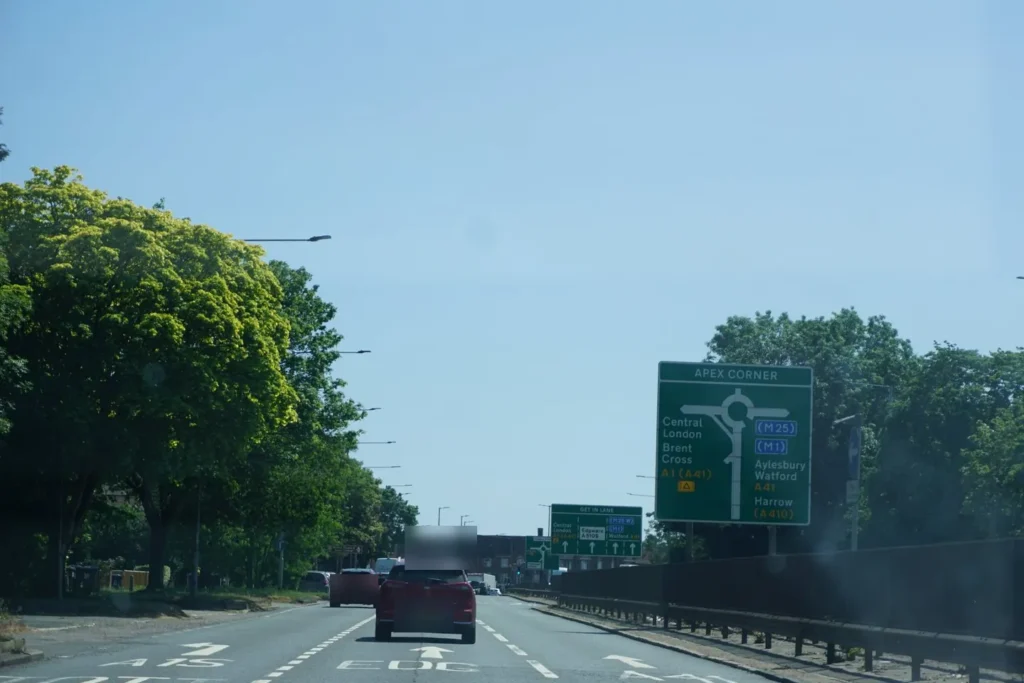
Junction observation is the top reason on DVSA's fail list. Its examples include pulling out without judging the speed of an approaching vehicle, and going onto a roundabout when a vehicle is coming from the right. Others are looking late or not at all, joining a dual carriageway from a slip road without checking, and going straight over a crossroads without looking.
Our guide to who has priority at junctions covers T-junctions, crossroads and give way lines in detail. Every test centre has its own awkward junctions, so find your test centre and watch the roads around it before the day. Each centre page also lists the fail points we noted there, including positioning and lane changes.
The examiner marks observation under several headings on your result. GOV.UK's guide to the result gives these examples:
| Heading | Examples of faults |
|---|---|
| Use of mirrors | checking the mirrors after signalling; changing lanes on a roundabout or dual carriageway without effective checks |
| Move off | not checking blind spots; moving off into the path of an oncoming vehicle |
| Junctions | misjudging the speed of an approaching vehicle; not checking for traffic when joining a dual carriageway |
| Positioning | driving too close to the pavement; straddling lanes |
| Reverse park, Reverse / right | not taking effective all-round observation; relying on just the mirrors |
Each mistake is marked as a driving, serious or dangerous fault, depending on what was around you. A late check with nobody near may be a driving fault. The same check missed with a car alongside may be serious.
Repeating the same driving fault can also turn it into a serious one. How driving test faults are marked explains the pass mark.
The top 3 reasons for failing in DVSA's list for April 2024 to March 2025 are all about observation:
Poor positioning on the road during normal driving is 9th. DVSA's mirror examples include leaving a roundabout without checking your mirrors and changing lanes on a roundabout with a vehicle alongside. The full top 10 reasons for failing explains each one.
Other habits to watch for on lessons:
For a full plan from lessons to test day, see how to pass your driving test.
A quick look over your shoulder into the area beside and just behind the car that your mirrors do not show. Rule 159 asks for it before you move off.
Before you move off, including after a normal stop and after pull up on the right, and before you reverse. Before a lane change, rule 133 asks for a quick sideways glance where necessary.
Yes, it is one of the driver aids allowed in the test car. You still need to make your own checks, because driver aids do not reduce your responsibility (rule 150).
There is no separate limit. Mirror faults count towards the 15 driving faults allowed, but one serious mirror fault, or the same fault repeated, can fail you.
Last checked: 13 October 2026.
