Three things decide whether your test goes ahead: your licence, a car that meets the rules and, if you need them, your glasses. Check them the night before and arrive calm.
8 min read·Beginner
TRWritten by the Testroute teamChecked against DVSA guidance and The Highway Code · Updated 13/10/2026
What to bring to your driving test: your UK photocard driving licence, your theory test pass certificate if you have it, and a car that meets the test rules. Bring glasses or contact lenses if you need them to read a number plate. Without the right things, your test is cancelled and you lose the fee.
What to bring to your driving test: the checklist
GOV.UK lists three things you must take. Pack them the night before.
Your UK driving licence. This is your provisional photocard licence.
Your theory test pass certificate, if you still have it. If it is lost, you do not need a replacement, because the examiner checks your pass before the test starts.
A car that meets the rules. Most learners use their instructor's car. You can use your own if it meets every rule below.
A few more things are not on the official list but can save your test:
Glasses or contact lenses, if you need them to read a number plate. You wear them for the eyesight check and for the whole drive.
Your booking confirmation email. It has the test centre's phone number, which you need if the weather is bad on the day.
Time to spare. DVSA asks you to arrive at the test centre 5 minutes before your appointment. Being late is one of the reasons tests are cancelled.
Forgot your licence for the driving test?
GOV.UK is clear: your test will be cancelled and you will not get your money back if you do not take the right things with you. You then book and pay again, which costs £62 on a weekday or £75 in the evening, at weekends or on bank holidays, and you wait for a new date.
It happens more often than you might think. DVSA's Ready to Pass campaign says 2,281 driving tests were cancelled in July 2026 because people brought an unsuitable car, forgot their driving licence or were late.
If your licence is lost
Apply for a replacement straight away. It can take up to 15 days to arrive. If it will not come in time, move your test, and do it at least 10 full working days before the test date so you keep your fee.
If you have an old paper licence
If you do not have a photocard licence, bring a valid passport and your paper licence.
If you no longer look like your photo
You must be recognisable from the photo on your licence. Small changes such as dyed hair or a beard are fine. If you could not be recognised from it, change the photo before your test.
Free practicePractise the show me tell me questionsAll 21 questions with short answers and a quick quiz.
If you use your instructor's car, they will have it ready. If you use your own car or a family car, check every rule, because a car that does not meet them means a cancelled test and a new fee.
The car must:
be taxed, insured for a driving test, and have a current MOT if it is over 3 years old
be roadworthy, with no warning lights showing safety issues
have no tyre damage, the legal tread depth on every tyre and no space-saver spare fitted
be able to reach at least 62 mph and have an officially fitted mph speedometer
have 4 wheels and a maximum authorised mass of no more than 3,500 kg
have L plates on the front and rear
have an extra interior rear-view mirror for the examiner
have a passenger seatbelt and a proper passenger head restraint for the examiner, not a slip-on type
Some cars cannot be used because they do not give the examiner a clear view all round, including any panel van and several convertibles. Our guide to taking the driving test in your own car has the full list and a checklist.
A dashcam is fine if it faces outside, does not film inside the car and does not record sound inside. Driver aids such as parking sensors, cruise control and lane assist are allowed. You cannot use self-parking or your own sat nav: the examiner brings a sat nav for independent driving.
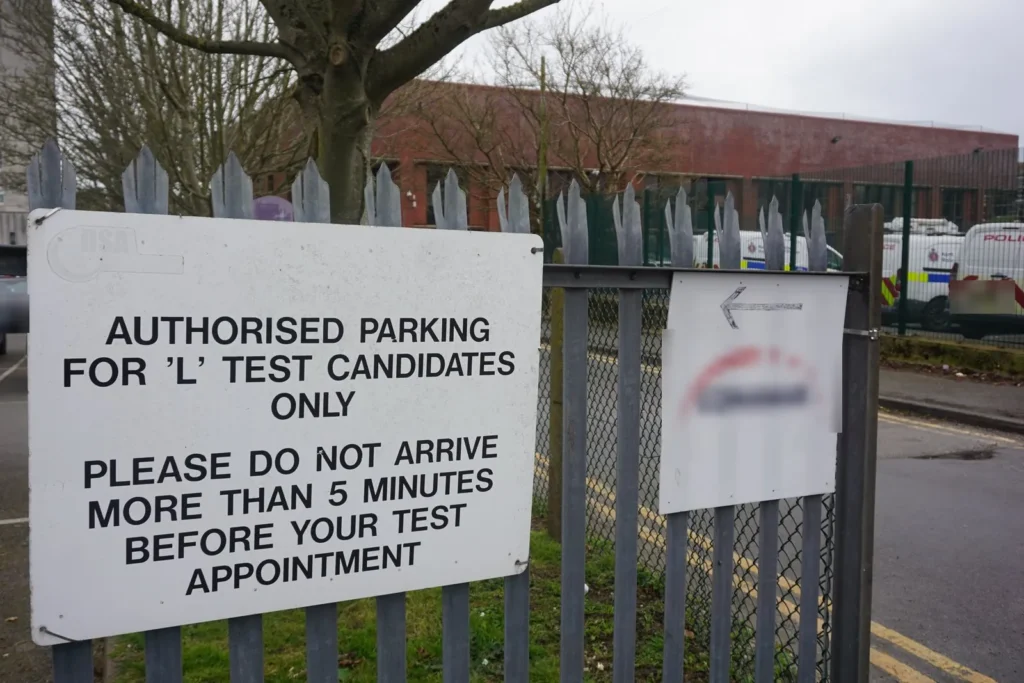
A sign reserving parking for L test candidates at the Folkestone test centre car park, March 2026
What to expect when you arrive
Aim to arrive 5 minutes before your appointment, as DVSA asks, and allow time to park. If your test includes the reverse bay park, it may happen in the test centre car park at the start of the test, so park neatly and watch the bays as you arrive.
The examiner meets you and asks if you would like someone to sit in the back during the test, usually your instructor. You can also have someone with you for the result and feedback. They must be over 16 and cannot take any part in the test.
After the checks below, you get one tell me question before you drive and one show me question while you drive. You can practise the show me tell me questions for free beforehand. Our minute by minute guide to how long a driving test takes covers the rest of the test.
What happens after you arrive: the checks, the drive and your result.
What the examiner checks before you drive
Before you move off, the examiner checks a few things. Each one can end the test before it starts.
Your licence and your face. The examiner checks your licence and that you match the photo.
A declaration. You read and sign a statement about the car's insurance and where you live. You must have lived in England, Wales or Scotland for at least 185 days in the 12 months before your test.
Your theory test pass. If there is no evidence of a pass on record, the test cannot go ahead.
Your eyesight. You read a number plate from 20 metres. If you cannot read it because you have forgotten or broken your glasses, the test is stopped. Our guide to the driving test eyesight check explains how it works.
Once you are driving, the examiner marks faults. You can have up to 15 driving faults and no serious or dangerous faults. Our guide to driving test faults explains how each type is judged.
Put your licence and your glasses in one place the night before, and check both again before you leave. A forgotten licence ends the test before it starts.
The night before and the morning of your test
A little checking the day before saves a wasted test.
Check the weather. Tests do not go ahead in dangerous conditions. If the weather is bad on the day, call your test centre on the number in your booking confirmation email. If DVSA cancels for bad weather, it books the next available date for you and sends the details within 3 working days, or up to 7 in a long spell of bad weather.
Feeling ill? You can cancel right up to the start of your test. You may get a refund at short notice for illness or injury if you can show proof, such as a medical note.
Warm up. A short lesson just before the test settles your nerves and gets you used to the car again.
Know the area. If you have not driven much around the centre yet, find your test centre on Testroute and watch the roads around it in 4K.
What do I need to bring to my driving test in the UK?
Your photocard driving licence, your theory test pass certificate if you have it, and a car that meets the rules. Bring glasses or lenses too if you need them to read a number plate.
What happens if I forget my licence?
Your test is cancelled and you do not get your money back. You then book and pay for a new test.
Do I need my theory test certificate?
Only if you have it. If it is lost, you do not need a replacement, because the examiner checks that you passed before the test starts.
Can I take my test in my own car?
Yes, if it meets all the rules, including an extra mirror for the examiner, L plates and a proper passenger head restraint. Your own car does not need dual controls, but a hire car does.
Do I have to wear a face covering?
No. In England, wearing a face covering on the test has been a personal choice for candidates and examiners since 1 March 2022.