Drive into a bay and reverse back out safely: where to turn in, how to finish inside the lines, which checks matter when you reverse out, and how the examiner marks it.
Forward bay parking means driving forwards into a bay of your choice, finishing inside the lines, then reversing out to the left or the right. Approach slowly with plenty of room, turn in at your reference point, and take your time over the all-round checks before and during the reverse out.
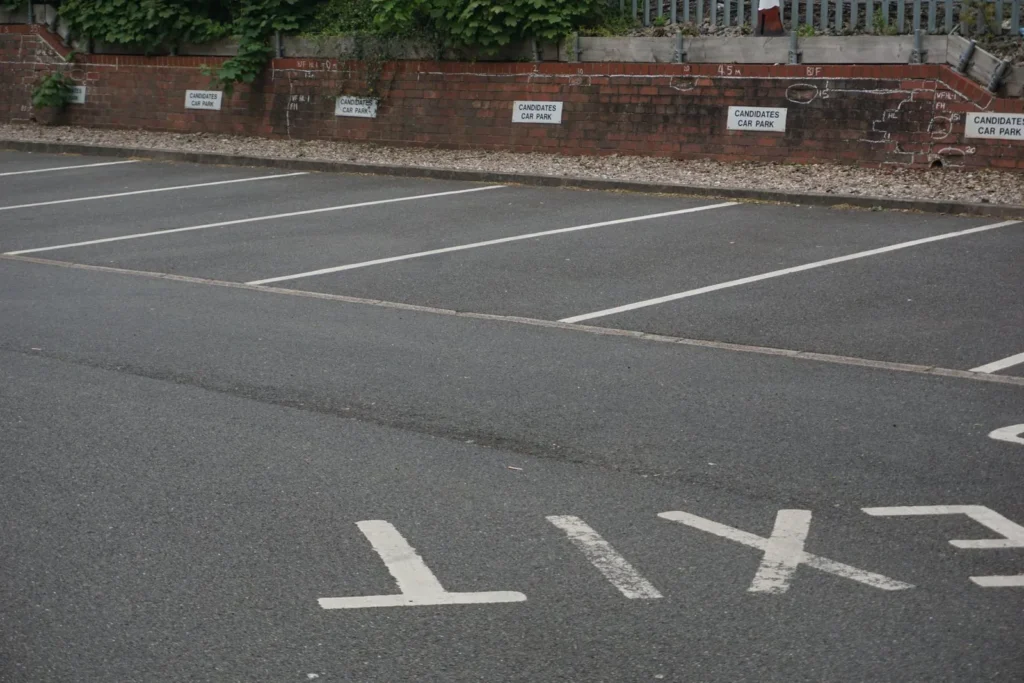
Forward bay parking is one version of the bay park, and the examiner chooses which reversing exercise you get. It is normally done in a car park along the test route, though in exceptional cases it can be done at the test centre. It does not have to be between two parked cars.
The examiner asks you to drive forward into a convenient bay, to the left or the right if the car park allows, and to finish within one of the bays. Then they ask you to reverse out to the left or the right. If the car park has one-way arrows, the examiner will direct you, and afterwards they direct you out of the car park.
Faults for this exercise are recorded from the moment the examiner tells you to pick a bay, so your approach counts too.
Reference points vary between cars and drivers, so the ones here are a starting point for your instructor to adjust.
If you have the choice, pick a bay on the right. You have the width of the aisle to swing into, and its lines are on your side of the car, where you can see them. These steps are for a bay on the right.
For a bay on the left, approach with as much room on your left as the aisle safely allows, check your left blind spot, and watch the left side of the car as you turn. When you drive forwards round a tight turn, the rear wheels cut inside the front wheels, so the back corner can clip a car in the next bay.
Reversing out needs the most care. You are backing into an aisle that people walk and drive along, often from between taller vehicles that block your view.
Keep the car at a crawl both ways. In a manual, use clutch control. In an automatic, let the car creep and control it with the footbrake. Slow speed gives you time to steer fully and to look.
The examiner guidance expects effective all-round observation and consideration for other road users and pedestrians. Look out for people walking behind parked cars, children, trolleys and drivers reversing out of their own bays. If someone comes close, stop. Once they have passed or have clearly stopped for you, carry on, because waiting too long for other car park users is a listed fault. Our guide to observation on your test covers blind spot checks in more detail.
The examiner is looking for accurate control into the bay and effective all-round observation. The examiner guidance grades the finish like this:
| Fault | Example from the examiner guidance |
|---|---|
| Driving fault | Finishing with one or two wheels on a bay line |
| Serious fault | Finishing with one or two wheels fully in the next bay, or an unacceptably poor standard of control over speed or direction |
| Dangerous fault | Losing control so the examiner has to act to stop you hitting a vehicle in the next bay |
The listed control faults are poor co-ordination of the controls, ending up straddling two bays, unnecessary shunting forwards and backwards, steering the wrong way and stalling. The observation faults are no blind spot checks, relying too much on the mirrors, ineffective observation, looking but not reacting, and waiting too long for others.
Examiners are told not to normally penalise crossing the lines as you drive in. Where you finish is what counts. You pass with up to 15 driving faults and no serious or dangerous faults: see how driving test faults are graded.
If you can see the car is heading over a line, stop before you finish there. Look all around, reverse back a little in a straight line, then drive in again at a better angle. One or two wheels on a line is a driving fault, but wheels fully in the next bay is a serious fault, so a correction is worth it.
If you are too close to the car beside you, stop before you touch it. Reverse a short way, straighten, and drive in again.
Make every correction slowly and with fresh all-round checks. Keep the number of shunts down, because unnecessary shunting is a listed fault. GOV.UK says you can carry on if you make a mistake, and that it might not affect your result if it is not serious.
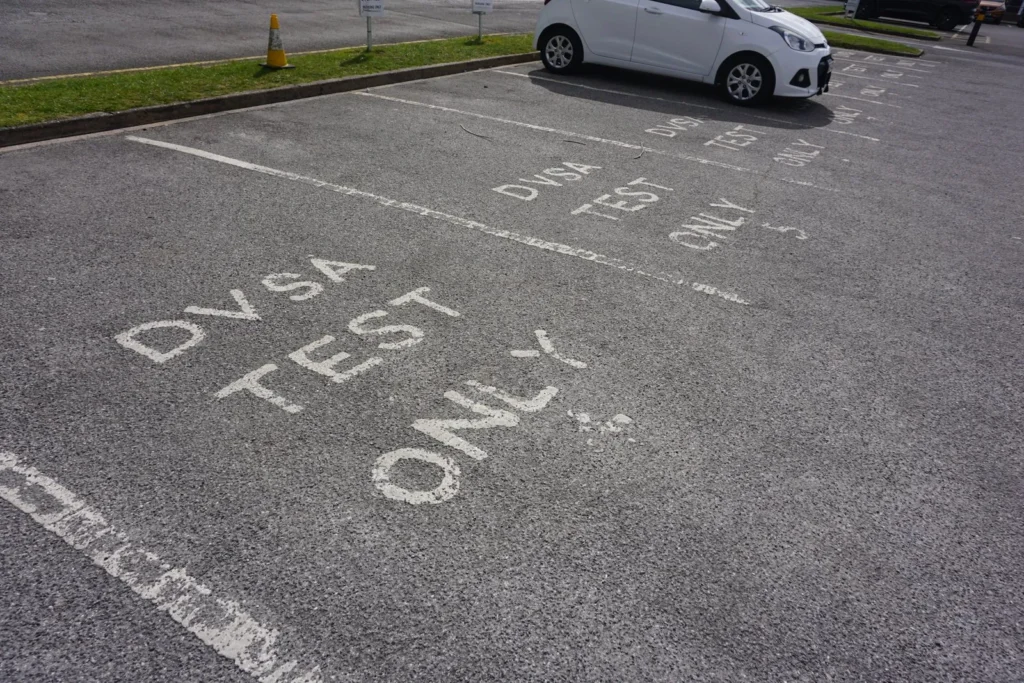
Practise in supermarket and retail car parks at quiet times, with bays on both sides and different bay widths. Practise reversing out to the left and to the right, and in car parks with one-way arrows.
Learn the other version too: our reverse bay parking reference points take you through backing into a bay. You can also watch the forward bay park filmed in 4K before your next lesson.
The forward park happens somewhere along your drive, so it helps to know the roads around your test centre. Find your test centre and watch them in 4K. For everything else, start with how to pass your driving test.
It is another name for forward bay parking: you drive into the bay forwards, then reverse out.
It depends on your car and your seat. A common one is to steer when your door mirror lines up with the near line of the bay, then adjust it with your instructor.
Examiners are told not to normally penalise crossing the lines as you enter. What matters is where you finish: one or two wheels on a line is a driving fault, and wheels fully in the next bay is a serious fault.
Normally it is done in a car park along the route, though in exceptional cases it can be done at the test centre. The reverse bay park is the one done in the test centre car park.
The examiner tells you to reverse out to the left or the right. If the car park has one-way arrows, they will direct you.
Last checked: 13 October 2026.
